According to scripture in the book of Luke 1:26, Elizabeth is six months pregnant on the vernal (spring) equinox (20 March) which is the same day Mary gets pregnant with Jesus . Thus, we see Elizabeth is
We detect an energy problem. Elizabeth who conceives in the autumn must endure the lack of heat during gestation because her fetus grows within her during the months where the daylight is less and the sun's energy is lowest. On the other hand, Mary's gestation period occurs during the months when the daylight is longest thus she captures a greater amount of heat or energy than Elizabeth during her term even though the timing of the birth of Jesus occurs when the length of night time is at its Zenith. There is a synergistic energy exchange between the mother and fetus during gestation which influences fetal development. Thus, Jesus is able to maximize the sun's energy during fetal development ( greater vitamin D absorption which prevents pelvis contraction during childbirth) more so than John the Baptist because his gestation period is over the summer. To conclude, given two mothers of equal make up, Jesus is superior to John due to the celestial timing of conception.
So, as you can see, there is alot going on in the space time continuum.
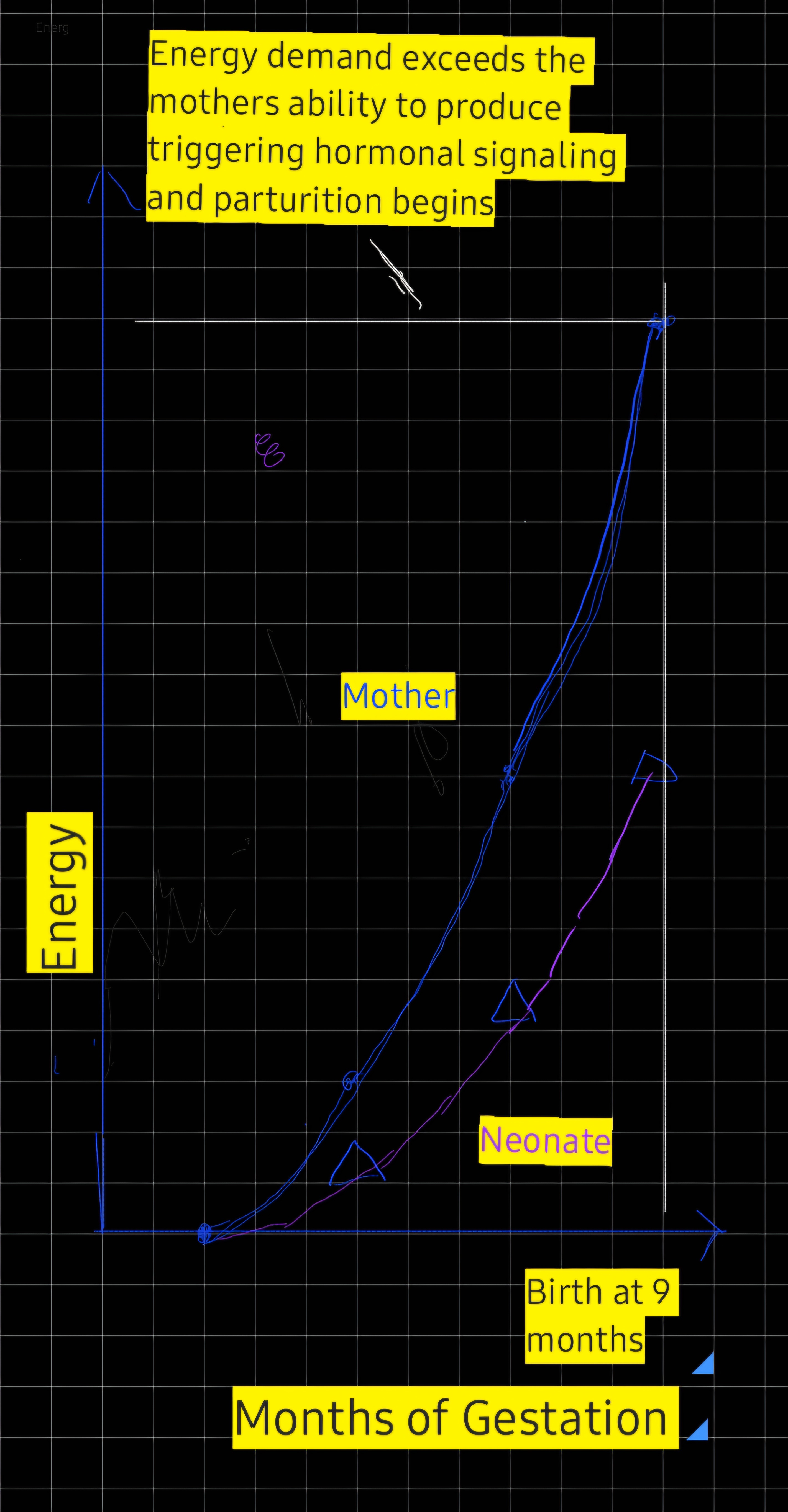
Scientifically speaking, the Energetics of Gestation and Growth hypothesis or EGG hypothesis, formulated by Professor Holly Dunsworth, suggest that metabolic constraints limit how large a fetus can grow before parturition (birth), which offers different insight to the birthing equation and the long standing “obstetric dilemma”. According to the EGG hypothesis the internal struggle to balance the maternal and fetal metabolism(energy production and consumption) sets up an iteration internally within the mother. At some point when the mother is no longer able to produce enough energy to maintain for both herself and the fetus ( on average 9 months ), Parturition (birth) begins. That is, the neonate completes the first phase in development exiting the womb and begins phase 2 as a fetus outside the womb.
As we all know, humane babies are not walking and chewing gum once they arrive in the outside world like other animals. A humane baby will exit the mother with a basic external package, and must be cradled during phase 2 development. That is, the fetus exits the mother unable to provide for itself and must reside in an external caring situation. Humans rely on a social structure.
This energy exchange between mother and “baby inside the womb” is augmented by the external thermal environment. Reflecting on the biblical celestial paradigm illustrated in the book of Luke 1:26, suggest a warmer thermal envelope during gestation superiorly compliments the internal energy demands of the mother allowing greater resources to be applied to development. Thus, by following biblical timing principles humans are able to produce a superior product.
awareshe is pregnant with John the Baptist on the Autumn Equinox ( 22 September). Remember, the vernal equinox occurs when the subsolar point ( point where the sun's rays are perpendicular to the surface of the earth, or the sun is directly overhead) crosses the equator while migrating into the northern hemisphere. At the vernal equinox the amount of time for daylight equals the amount of time for darkness, and for each day after the vernal equinox the amount of daylight for each day increases in the northern hemisphere. Remember, the sun oscillates in a sinusoidal fashion between the summer (subsolar point is on the Tropic of Cancer) and winter (subsolar point is on the Tropic of Capricorn) solstices completing one full cycle in one year. The timing of pregnancies between Elizabeth who is six months with John the Baptist and Mary mother of Jesus, that coincides with celestial events, is celebrated on the 25th of March ( 3 to 4 days after the vernal equinox or spring equinox), and known in Christian circles as the Annunciation to the Blessed Virgin Mary which usually is celebrated with a big feast. Now this all occurs nine months before Jesus' birthday which is celebrated on the 25th of December 3 to 4 days after the winter solstice (21st of December). At the time of the winter solstice the subsolar point is at the Tropic of Capricorn in the southern hemisphere, and the amount of darkness during night time is the greatest in the northern hemisphere. It is important to remember Jesus is born in a manger managed by Levite priests who take care of the sacrificial sheep. The Sheep are an important clue, because they were bred to be the best sheep. That is, sheep without a blemish. To sum it all up. Elizabeth conceives with John the Baptist on the autumn equinox. Six months later, Mary discovers she is pregnant on the Vernal equinox. Three months later, Cousin John the Baptist was born on the Summer Solstice( 20 June). Six months later, Jesus is born on the winter solstice. So, we see John the Baptist is born when the day is long, and Jesus is born when the night is long. Elizabeth and Mary both conceive when the day and night are of equal length. However, Elizabeth conceives in the Autumn (thermal energy from the sun is decreasing) and Mary conceives in the Spring (thermal energy from the sun is increasing) .
We detect an energy problem. Elizabeth who conceives in the autumn must endure the lack of heat during gestation because her fetus grows within her during the months where the daylight is less and the sun's energy is lowest. On the other hand, Mary's gestation period occurs during the months when the daylight is longest thus she captures a greater amount of heat or energy than Elizabeth during her term even though the timing of the birth of Jesus occurs when the length of night time is at its Zenith. There is a synergistic energy exchange between the mother and fetus during gestation which influences fetal development. Thus, Jesus is able to maximize the sun's energy during fetal development ( greater vitamin D absorption which prevents pelvis contraction during childbirth) more so than John the Baptist because his gestation period is over the summer. To conclude, given two mothers of equal make up, Jesus is superior to John due to the celestial timing of conception.
So, as you can see, there is alot going on in the space time continuum.
Scientifically speaking, the Energetics of Gestation and Growth hypothesis or EGG hypothesis, formulated by Professor Holly Dunsworth, suggest that metabolic constraints limit how large a fetus can grow before parturition (birth), which offers different insight to the birthing equation and the long standing “obstetric dilemma”. According to the EGG hypothesis the internal struggle to balance the maternal and fetal metabolism(energy production and consumption) sets up an iteration internally within the mother. At some point when the mother is no longer able to produce enough energy to maintain for both herself and the fetus ( on average 9 months ), Parturition (birth) begins. That is, the neonate completes the first phase in development exiting the womb and begins phase 2 as a fetus outside the womb.
As we all know, humane babies are not walking and chewing gum once they arrive in the outside world like other animals. A humane baby will exit the mother with a basic external package, and must be cradled during phase 2 development. That is, the fetus exits the mother unable to provide for itself and must reside in an external caring situation. Humans rely on a social structure.
This energy exchange between mother and “baby inside the womb” is augmented by the external thermal environment. Reflecting on the biblical celestial paradigm illustrated in the book of Luke 1:26, suggest a warmer thermal envelope during gestation superiorly compliments the internal energy demands of the mother allowing greater resources to be applied to development. Thus, by following biblical timing principles humans are able to produce a superior product.